
Hydrogen Storage and Distribution System Components
By Nick Li · August 10, 2026 · Technical Articles
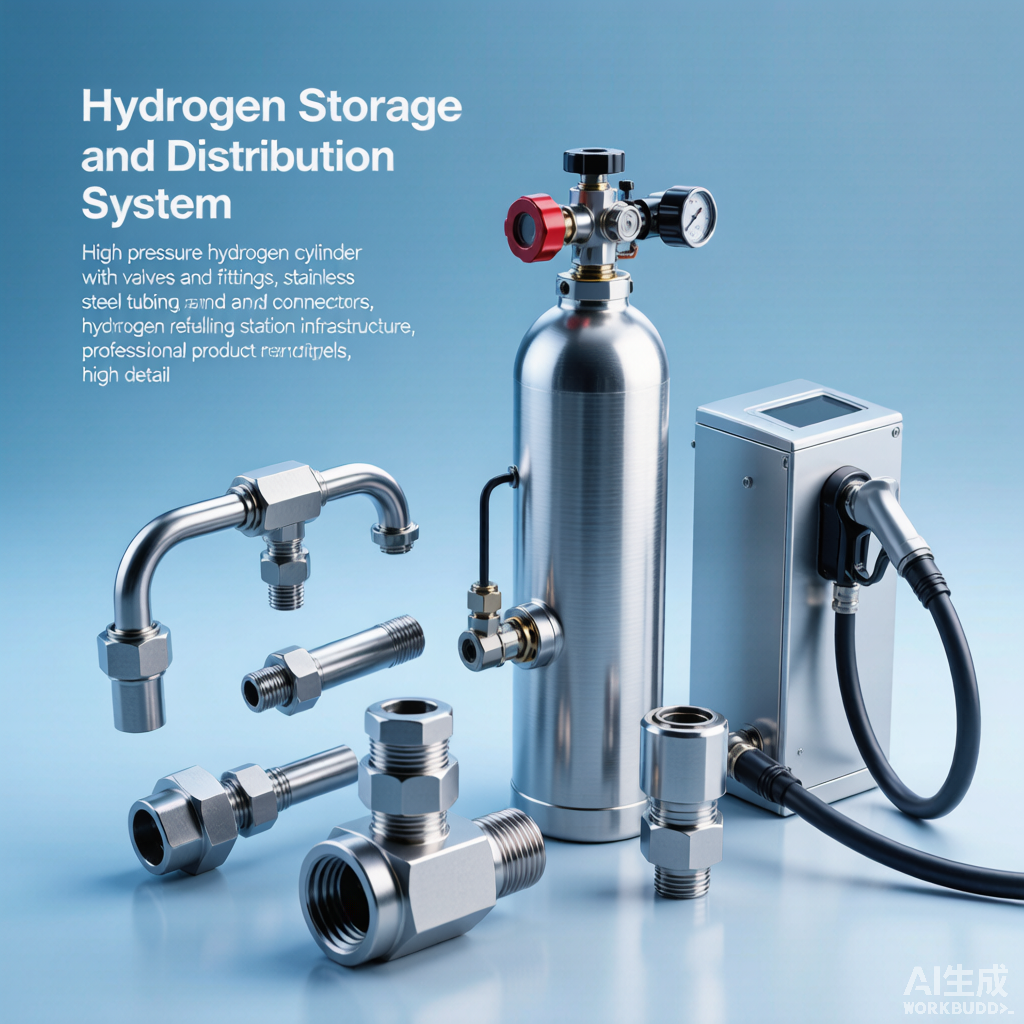
As the global hydrogen economy accelerates, the design and selection of hydrogen storage and distribution system components has become critical. Hydrogen’s unique properties – small molecular size, high diffusion rate, and embrittlement effects – demand specialized fluid system engineering. This article covers the key considerations for hydrogen service component selection and system design.
1. Hydrogen Properties and Engineering Challenges
Hydrogen is the smallest and lightest molecule in the periodic table. Its physical properties present unique engineering challenges that must be addressed in every component design decision.
| Property | Value | Engineering Implication |
|---|---|---|
| Molecular size | 0.289 nm (H2) | Permeates through metals, requires tight seals |
| Density (gas, STP) | 0.0899 kg/m3 | Low mass flow per volume |
| Diffusion coefficient | 0.61 cm2/s in air | Rapid dispersion, leak detection difficulty |
| Flammability range | 4-75% in air | Very wide explosion envelope |
| Embrittlement | Affects high-strength steel | Material selection is critical |
2. Compressed Hydrogen Storage Systems (CHSS)
Compressed hydrogen storage systems (CHSS) store hydrogen at high pressures, typically 350 bar or 700 bar for vehicle and station applications. The system components must withstand cyclic loading, extreme pressures, and hydrogen embrittlement.
- Type IV cylinders: carbon fiber composite with polymer liner, 700 bar service
- Pressure relief device (PRD): thermal activated, protects against over-temperature
- Isolation valve: positive shutoff between storage and distribution
- Refueling receptacle: standardized interface (SAE J2600) for vehicle fill
- Breakaway hose: separates at defined force to prevent catastrophic release
Figure 1: Hydrogen storage and distribution system with high-pressure components
3. Material Selection for Hydrogen Service
Material selection for hydrogen service is governed by the potential for hydrogen embrittlement (HE). Austenitic stainless steels, aluminum alloys, and certain nickel-based alloys are generally resistant to HE, while high-strength steels require careful evaluation.
| Material | HE Susceptibility | Max Pressure | Recommended Use |
|---|---|---|---|
| 316/316L SS | Low | 700 bar | Tubing, fittings, valves |
| 316L VIM/VAR | Very low | 1000+ bar | UHP hydrogen, extreme pressure |
| Alloy 625 | Very low | 1000 bar | High-pressure valve seats |
| 7075-T6 Aluminum | Low | 350 bar | Cylinder liners, manifolds |
| ASTM A105 carbon steel | High | Not recommended | Avoid direct H2 contact |
4. Fitting and Connection Technology
Hydrogen’s small molecular size demands superior sealing technology. Metal-to-metal seals are preferred over elastomeric seals for high-pressure hydrogen applications due to their resistance to permeation and explosive decompression.
- Twin ferrule compression fittings with 316L construction for pressures up to 6000 psig
- Metal face seal (VCR) for UHP hydrogen and pressures up to 10000 psig
- Coned and threaded connections for ultra-high pressure (>10000 psig) service
- Welded connections (orbital TIG) for permanent, zero-leakage distribution piping
- Verify fitting material compatibility with hydrogen embrittlement testing (per ASTM F1940)
5. Valve Selection for Hydrogen Applications
Valves in hydrogen service must provide positive shutoff, high cycle life, and fire-safe design. Valve seat materials, stem sealing, and body design all influence safety and reliability.
| Valve Type | Seat Material | Pressure Rating | Application |
|---|---|---|---|
| Ball valve | PCTFE or PEEK | Up to 10000 psig | Isolation, flow direction |
| Needle valve | Vespel or PCTFE | Up to 6000 psig | Flow regulation |
| Check valve | Metal seat or PCTFE | Up to 6000 psig | Backflow prevention |
| Relief valve | Metal-to-metal | Up to 10000 psig | Over-pressure protection |
6. Leak Detection and Safety Systems
Hydrogen leak detection requires specialized technology due to hydrogen’s colorless, odorless, and rapidly dispersing nature. Multiple detection layers provide defense-in-depth safety.
- Catalytic bead sensors: detect 1-100% LEL hydrogen concentration in air
- Electrochemical sensors: high sensitivity, 0-1000 ppm range for area monitoring
- Thermal conductivity sensors: for hydrogen purity verification in process streams
- Ultrasonic leak detectors: detect high-pressure gas leak by acoustic signature
- Integrate detection with automated shutdown and ventilation control (per NFPA 2)
7. Standards and Regulatory Framework
Hydrogen system design is governed by international standards that ensure safety, interoperability, and quality. Compliance with these standards is mandatory for commercial hydrogen infrastructure deployment.
| Standard | Scope | Key Requirements |
|---|---|---|
| SAE J2600 | H2 vehicle fueling receptacle | Standardized interface, 700 bar |
| SAE J2799 | H2 surface vehicle communication | Hardware for fueling protocol |
| ISO 19880 | Gaseous H2 fueling stations | Station design and safety |
| ASME B31.12 | Hydrogen piping and pipelines | Material selection, design rules |
| CGA G-5 | Hydrogen production and distribution | Safety standards for H2 systems |
Source: FITOK Technical Reference