
Material Selection for Corrosive Environment Fluid Systems
By Nick Li · August 10, 2026 · Technical Articles
Selecting the right material for fluid system components in corrosive environments is a critical engineering decision that impacts safety, reliability, and life-cycle cost. This article provides a systematic approach to material selection using quantitative corrosion indicators such as PREN and CPT, along with practical guidance for common corrosive service conditions.
1. Corrosion Mechanisms in Fluid Systems
Fluid system components face multiple corrosion mechanisms. Understanding each mechanism is the first step in selecting appropriate materials for specific service conditions.
| Mechanism | Description | Preventive Strategy |
|---|---|---|
| Pitting | Localized breakdown of passive film forming cavities | Higher PREN, Mo content |
| Crevice | Corrosion in stagnant areas (gaps, under deposits) | Eliminate crevices, higher alloy |
| SCC | Stress corrosion cracking under tensile stress + environment | Lower applied stress, duplex alloys |
| Galvanic | Dissimilar metals in electrolyte creating galvanic cell | Compatible metals, insulation |
| HE | Hydrogen embrittlement of high-strength steel | Use HE-resistant alloys (316 SS) |
| Erosion | Fluid velocity removing protective film | Lower velocity, harder material |
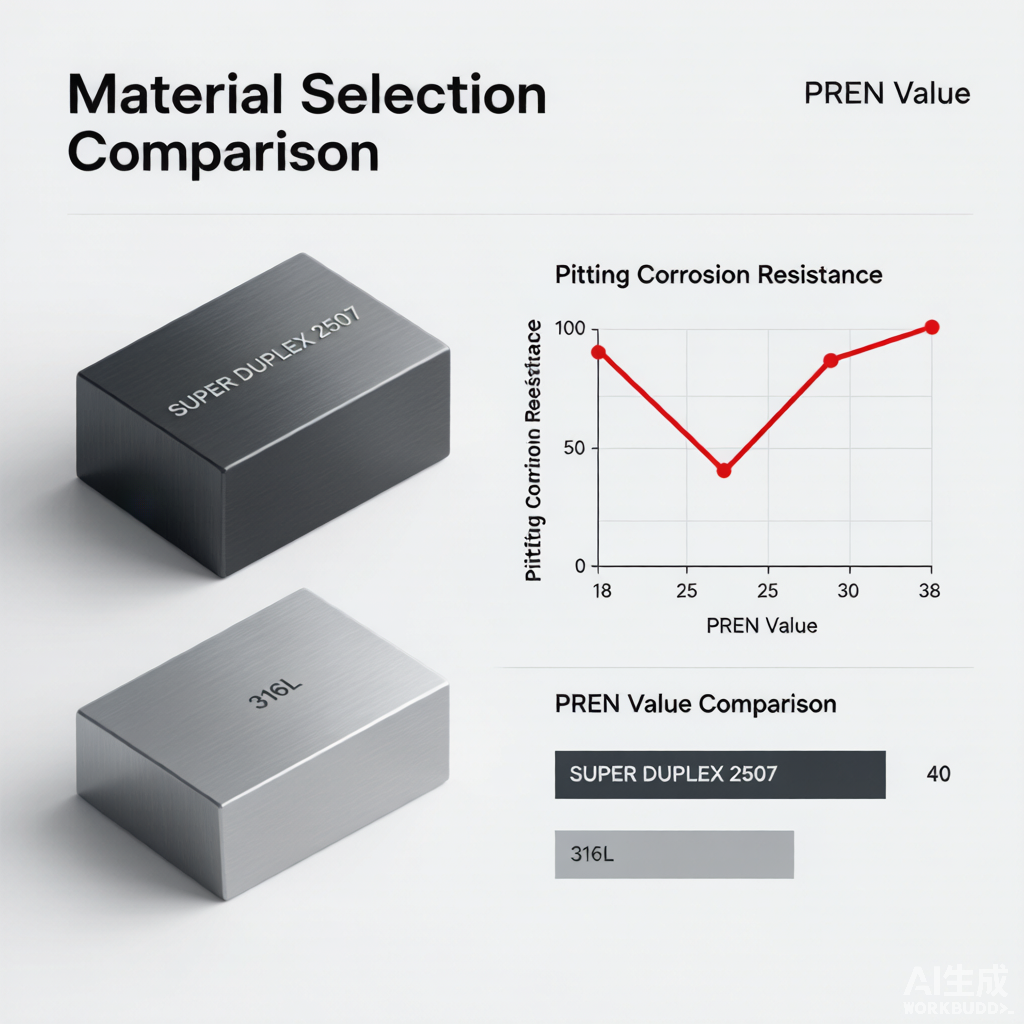
Figure 1: Material comparison chart showing PREN and CPT values for stainless steel grades
2. Pitting Resistance Equivalent Number (PREN)
PREN is a quantitative metric that predicts the relative pitting corrosion resistance of stainless steels. It is calculated from the critical alloying elements: chromium (Cr), molybdenum (Mo), and nitrogen (N).
- Formula: PREN = %Cr + 3.3 x %Mo + 16 x %N
- Higher PREN indicates better pitting resistance
- PREN > 32: suitable for seawater and moderate chloride service
- PREN > 40: suitable for high chloride and sour gas service
- Critical Pitting Temperature (CPT): the minimum temperature at which pitting initiates in a standardized test
3. Stainless Steel Grade Comparison
Stainless steels are the workhorse materials for fluid system components. Understanding the differences between austenitic, duplex, and super duplex grades is essential for cost-effective material selection.
| Grade | Type | PREN | CPT (C) | Key Advantages |
|---|---|---|---|---|
| 304 SS | Austenitic | 18-20 | 5-10 | Economical, general purpose |
| 316 SS | Austenitic | 24-26 | 15-20 | Standard for chemical processing |
| 316L SS | Austenitic (low C) | 24-26 | 15-20 | Welded construction, UHP |
| Duplex 2205 | Duplex | 34-38 | 35-45 | Higher strength, chloride resistance |
| Super Duplex 2507 | Super Duplex | 42-48 | 60-70 | Severe chloride, sour gas, high pressure |
| 904L | Austenitic (high alloy) | 35-40 | 40-50 | Sulfuric acid, phosphoric acid |
4. Nickel-Based Alloys for Extreme Service
When stainless steels are insufficient, nickel-based alloys provide superior corrosion resistance for the most demanding applications. These alloys come at significantly higher cost but offer unmatched performance in extreme environments.
| Alloy | UNS | Composition Highlights | Service Application |
|---|---|---|---|
| Alloy 625 | N06625 | Ni-Cr-Mo-Nb | High temp, oxidizing and reducing acids |
| Alloy 825 | N08825 | Ni-Fe-Cr-Mo-Cu | Sulfuric acid, phosphoric acid, sour gas |
| Alloy C-276 | N10276 | Ni-Cr-Mo-W | Strong oxidizers, wet chlorine |
| Alloy 400 | N04400 | Ni-Cu | Hydrofluoric acid, salt water |
| Alloy 20 | N08020 | Ni-Cr-Fe-Mo-Cu | Sulfuric acid at elevated temp |
5. Manufacturing Process Effects on Corrosion Resistance
The manufacturing process significantly affects the corrosion resistance of the final component. Advanced melting and refining processes produce cleaner, more uniform materials with superior corrosion properties.
- VIM (Vacuum Induction Melting): removes volatile impurities, high purity for UHP
- VAR (Vacuum Arc Remelting): improves homogeneity and reduces segregation
- ESR (Electroslag Remelting): reduces non-metallic inclusions, improves toughness
- AOD (Argon Oxygen Decarburization): controls carbon in stainless steel, reduces impurities
- Bright Anneal (BA): produces clean, oxide-free surface for improved passivation
6. Sour Gas Service (NACE MR0175/ISO 15156)
Sour gas service containing H2S presents specific challenges: sulfide stress cracking (SSC), hydrogen-induced cracking (HIC), and stress-oriented hydrogen-induced cracking (SOHIC). NACE compliance is mandatory for all pressure-containing components.
| Material | Max Hardness (HRC) | Max Temp (C) | SSC Region |
|---|---|---|---|
| 316/316L SS | 22 | 150 | Region 1-3 |
| Super Duplex 2507 | 28 | 232 | Region 1-3 (with restrictions) |
| Alloy 625 | 35 | 232+ | All regions |
| Alloy 825 | 35 | 232+ | All regions |
| Carbon steel (A105) | 22 | S2 region only | Limited (high SSC risk) |
7. Material Selection Decision Framework
A structured material selection process ensures all relevant factors are considered. The following decision framework provides a systematic approach from requirement definition to final material specification.
- Step 1: Define process fluid composition, temperature, pressure, and flow velocity
- Step 2: Identify potential corrosion mechanisms (pitting, SCC, galvanic, erosion)
- Step 3: Calculate minimum PREN requirement based on chloride content and temperature
- Step 4: Check NACE compliance if H2S is present in the process stream
- Step 5: Select candidate materials meeting all requirements (cost vs performance)
- Step 6: Verify availability of components in selected material (fitting, valve, tube)
- Step 7: Specify melting process, surface finish, and testing requirements in purchase spec
Source: FITOK Technical Reference