
Predictive Maintenance Strategies for Compressor Units
By Nick Li · August 10, 2026 · Technical Articles
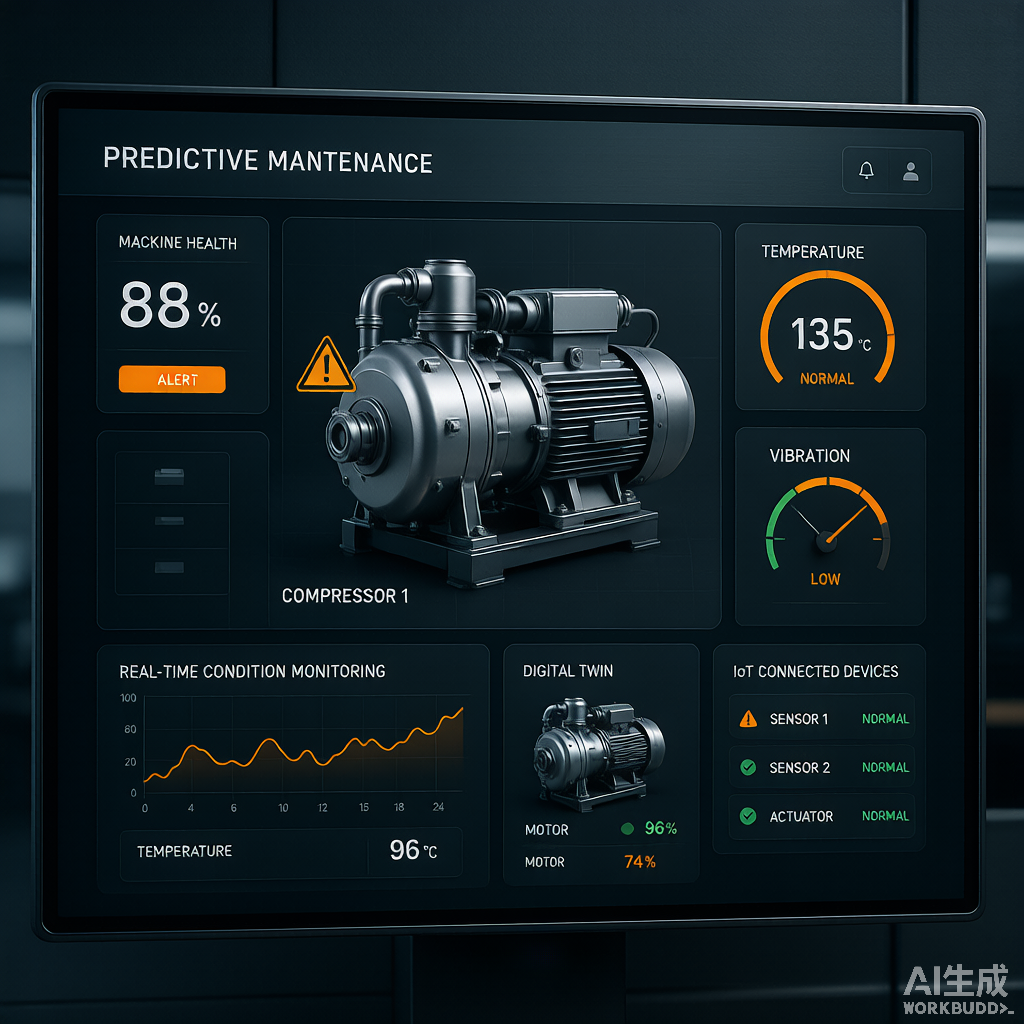
Predictive maintenance (PdM) represents a paradigm shift from time-based or reactive maintenance strategies. By continuously monitoring equipment condition, PdM enables maintenance interventions to be scheduled precisely when needed, maximizing equipment life while minimizing unplanned downtime. This article outlines a comprehensive predictive maintenance framework specifically designed for compressor units.
1. Foundation of Predictive Maintenance
Predictive maintenance is built on the principle that equipment degradation follows predictable patterns. By monitoring key indicators, the remaining useful life of components can be estimated with reasonable accuracy, allowing maintenance to be planned and executed before functional failure occurs.
| Maintenance Type | Trigger | Advantages | Limitations |
|---|---|---|---|
| Reactive | Failure occurs | No planning cost | High downtime, secondary damage |
| Preventive | Time interval | Simple to manage | Over-maintenance, no failure prevention |
| Predictive | Condition trend | Optimal timing, reduced downtime | Requires investment, expertise |
| Prescriptive | AI recommendation | Automated, optimized | High complexity, data quality needs |
2. Condition Monitoring Parameters
Effective predictive maintenance requires monitoring multiple parameters that collectively provide a comprehensive picture of compressor health. Each parameter captures different failure modes and degradation mechanisms.
2.1 Primary Monitoring Parameters
- Vibration: overall amplitude, spectral content, waveform shape, phase angle
- Temperature: bearing, discharge gas, lube oil, cylinder wall
- Pressure: suction, discharge, interstage, oil supply
- Flow: capacity, packing leakage, valve performance
- Oil quality: particle count, viscosity, water content, TAN
2.2 Monitoring Frequency Guidelines
| Parameter | Collection Method | Frequency | Alarm Basis |
|---|---|---|---|
| Vibration (overall) | Permanently mounted sensor | Continuous | ISO 10816 limits |
| Vibration (spectrum) | Walk-around or online | Monthly | Trend deviation |
| Bearing temperature | RTD/thermocouple | Continuous | Absolute + rate-of-rise |
| Oil analysis | Sample bottle | Monthly | ISO 4406 + elements |
| P-V diagram | Dynamic pressure sensor | Quarterly | Area deviation |
Figure 1: Predictive maintenance dashboard for compressor condition monitoring
3. Data Management and Trend Analysis
The value of condition monitoring data lies in its analysis. A robust data management system must collect, store, and analyze condition data to generate actionable maintenance recommendations.
- Implement a CMMS or dedicated condition monitoring software platform
- Establish baseline readings after installation or major overhaul
- Define normal, alert, and danger thresholds for each parameter
- Use statistical process control (SPC) charts for trend visualization
- Automate data collection from online sensors to minimize manual effort
4. Failure Mode and Effects Analysis (FMEA)
FMEA is a systematic method for identifying potential failure modes, their causes, and their effects on system performance. For compressor units, FMEA should be developed for each major component and updated based on actual failure experience.
| Component | Failure Mode | Detection Method | Risk Priority |
|---|---|---|---|
| Valves | Plate fracture/leakage | P-V diagram + vibration | High |
| Bearings | Spalling/fatigue | Vibration + oil analysis | Critical |
| Piston rings | Wear/breakage | P-V diagram + blowby | Medium |
| Packing | Wear/leakage | Leakage rate + temperature | Medium |
| Crankshaft | Fatigue crack | Vibration + oil analysis | Critical |
5. Remaining Useful Life (RUL) Estimation
Estimating RUL is the cornerstone of predictive maintenance. By combining condition monitoring data with degradation models, maintenance planners can schedule interventions at the optimal time.
5.1 Degradation Modeling Approaches
- Linear extrapolation: project current trend to threshold (simple, for steady wear)
- Exponential model: accelerating degradation (bearing spalling, crack growth)
- Probabilistic model: Weibull distribution based on population failure data
- Machine learning: trained on historical data for pattern recognition
- Physics-based model: first-principles simulation of degradation mechanism
6. Maintenance Planning and Scheduling
Predictive maintenance recommendations must be translated into actionable work orders. The planning process should consider equipment criticality, production scheduling, resource availability, and spare parts lead time.
| Alert Level | Action Timeline | Typical Response |
|---|---|---|
| Early warning | Next planned shutdown | Plan inspection, order spares |
| Alert | Within 30 days | Schedule intervention, confirm spares |
| Danger | Within 7 days | Immediate action or risk-managed run |
| Critical | Immediate | Emergency shutdown and intervention |
7. Continuous Improvement and Program Maturity
A predictive maintenance program is never static. It must evolve with equipment condition changes, process modifications, and organizational learning. Regular program reviews ensure that monitoring strategies remain effective and cost-efficient.
- Conduct quarterly program effectiveness reviews (downtime reduction, cost savings)
- Update alarm thresholds based on operating experience and false alarm analysis
- Incorporate new monitoring technologies as they become cost-effective
- Document all failure case studies and feed back into FMEA updates
- Benchmark program maturity against industry standards (ISO 17359, API 689)
Source: Compressor Technology Editorial Reference