
Quick Disconnect Coupling Technology for Data Center Liquid Cooling
By Nick Li · August 10, 2026 · Technical Articles
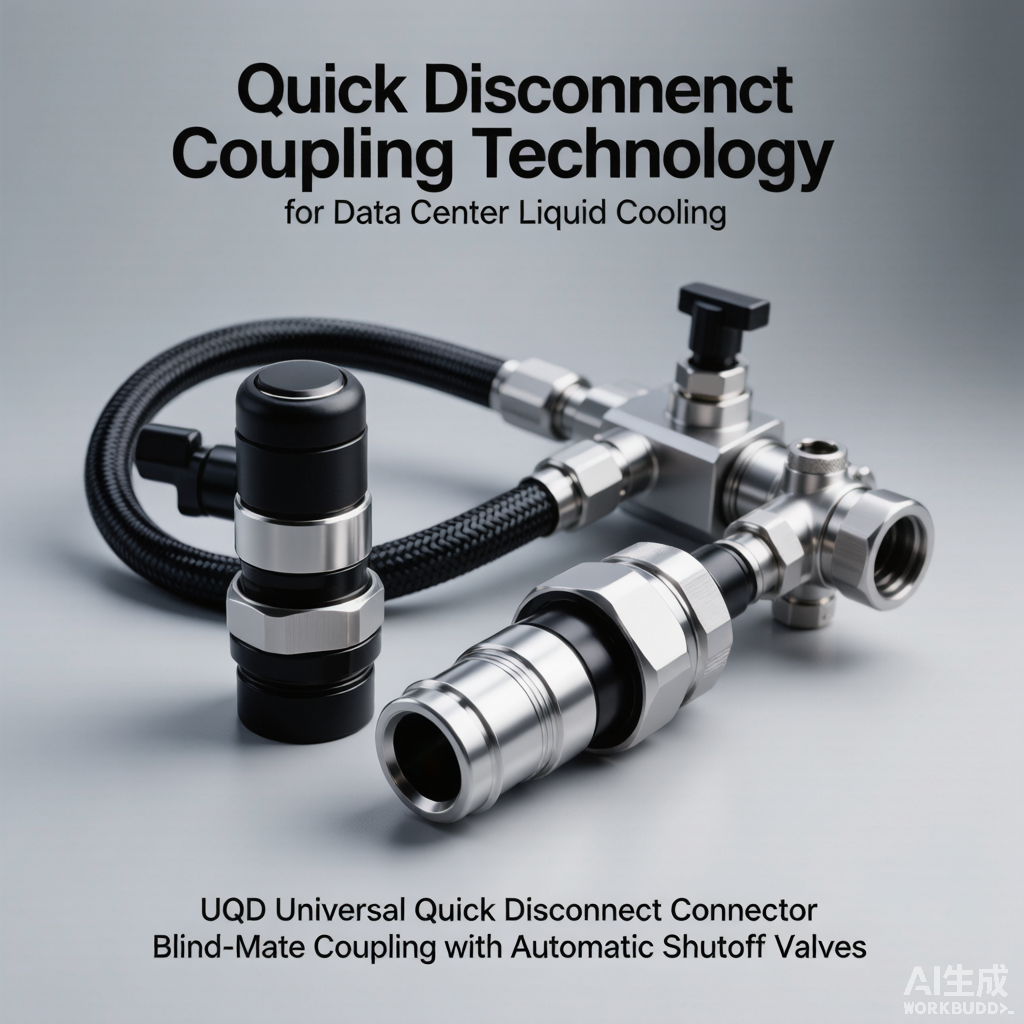
As data center power densities increase beyond air cooling capacity, liquid cooling has become essential. Quick disconnect (QD) couplings are critical components that enable safe, leak-free connection and disconnection of liquid cooling lines. This article examines QD coupling technology, specifically the Universal Quick Disconnect (UQD) and blind-mate (UQDB) variants that have become industry standards for data center liquid cooling.
1. Liquid Cooling Architecture Overview
Modern data center liquid cooling systems use either direct-to-chip (cold plate) or immersion cooling. Both architectures require quick disconnect couplings at the rack interface to enable hot-swap maintenance without draining the entire cooling loop.
- Coolant distribution unit (CDU): central pump, heat exchanger, and control
- Manifold to rack (M2R): supply and return manifolds with QD connections
- Rack to node (R2N): individual server liquid connections within the rack
- Cold plate: direct-to-chip cooling with internal micro-channels
- Quick disconnect: enables tool-free connection and disconnection
Figure 1: UQD blind-mate coupling technology for data center liquid cooling
2. Universal Quick Disconnect (UQD) Design
The UQD standard defines a universal interface for data center liquid cooling. Single-end shutoff (SESO) and double-end shutoff (DESO) configurations are available, with DESO being preferred for data center applications to prevent coolant spillage during disconnection.
| Feature | SESO (Single-End Shutoff) | DESO (Double-End Shutoff) |
|---|---|---|
| Valve configuration | One side has valve, other is open | Both sides have automatic shutoff valves |
| Spillage on disconnect | Fluid drains from open side | Minimal to zero spillage |
| Pressure drop | Lower (one valve restriction) | Slightly higher (two valves) |
| Recommended use | Low pressure, non-hazardous coolant | Data center, high-reliability service |
3. Blind-Mate Coupling (UQDB)
The Universal Quick Disconnect Blind-Mate (UQDB) is designed for situations where visual alignment is not possible – such as server installation in dense rack environments. The coupling features self-aligning geometry that tolerates angular and lateral misalignment while maintaining a leak-free connection.
- Self-aligning guide features: floating interface accommodates +/- 2 mm lateral misalignment
- Angular tolerance: +/- 3 degrees from nominal axis
- Audible/ tactile click: confirms successful engagement without visual verification
- Valve sequencing: opens supply before return to prevent pressure imbalance
- Color coding and keying: prevents cross-connection between supply and return lines
4. Performance Specifications
Data center QD couplings must meet stringent performance requirements for flow capacity, pressure rating, temperature range, and leak integrity. These specifications ensure reliable operation under high-density computing loads.
| Parameter | Specification | Test Method |
|---|---|---|
| Flow rate | > 10 L/min at 0.1 bar pressure drop | Flow bench test |
| Working pressure | 50-100 psig (3.5-7 bar) | Hydrostatic test at 4x rated |
| Temperature range | 5-80 C continuous operation | Thermal cycling test |
| Leak rate (connected) | < 10^-6 atm cc/sec helium | Helium mass spectrometer |
| Leak rate (disconnected) | < 0.05 mL per disconnection | Gravimetric measurement |
| Cycle life | > 10,000 connect/disconnect cycles | Automated cycle test |
5. Material and Seal Selection
Coolant compatibility and long-term seal integrity drive material selection for data center QD couplings. The most common coolants are water-glycol mixtures, dielectric fluids, and single-phase immersion fluids.
| Component | Material | Compatibility |
|---|---|---|
| Body | PPS (polyphenylene sulfide) or 316 SS | Chemically resistant, high temp |
| Seals (O-rings) | EPDM or FFKM (perfluoroelastomer) | Compatible with glycol, low outgassing |
| Valve seats | PCTFE or PEEK | Hard seating, long cycle life |
| Springs | 316 SS or Elgiloy | Corrosion resistant, low fatigue |
| Guide features | PPS or PEEK | Low friction, self-lubricating |
6. Installation and Maintenance Best Practices
Proper installation and maintenance of QD couplings ensures long-term leak-free performance. Following manufacturer guidelines and implementing preventive maintenance protocols reduces the risk of coolant leaks in production data centers.
- Inspect coupling interface for damage before each connection
- Listen for audible click and verify engagement indicator
- Never force a misaligned coupling – realign and retry
- Replace coupling after maximum cycle count (per manufacturer specification)
- Perform quarterly visual inspection for signs of weepage or corrosion
- Maintain a spare coupling inventory for rapid replacement during maintenance windows
7. Industry Standards and Development
The data center liquid cooling industry is developing standards for QD coupling interfaces to ensure interoperability between equipment from different manufacturers. Key initiatives include the Open Compute Project (OCP) and ASHRAE liquid cooling guidelines.
- OCP Advanced Cooling Facility (ACF): standardizing UQD interface for M2R connections
- ASHRAE TC9.9: liquid cooling guidelines for data center design
- SEMI D66: specification for liquid cooling interconnects in data centers
- OIF IA: optical internetworking forum for liquid cooling interfaces
- Vendor-specific implementations converging toward universal UQD standard
Source: FITOK Technical Reference