
Reciprocating Compressor Installation and Commissioning
By Nick Li · August 10, 2026 · Technical Articles
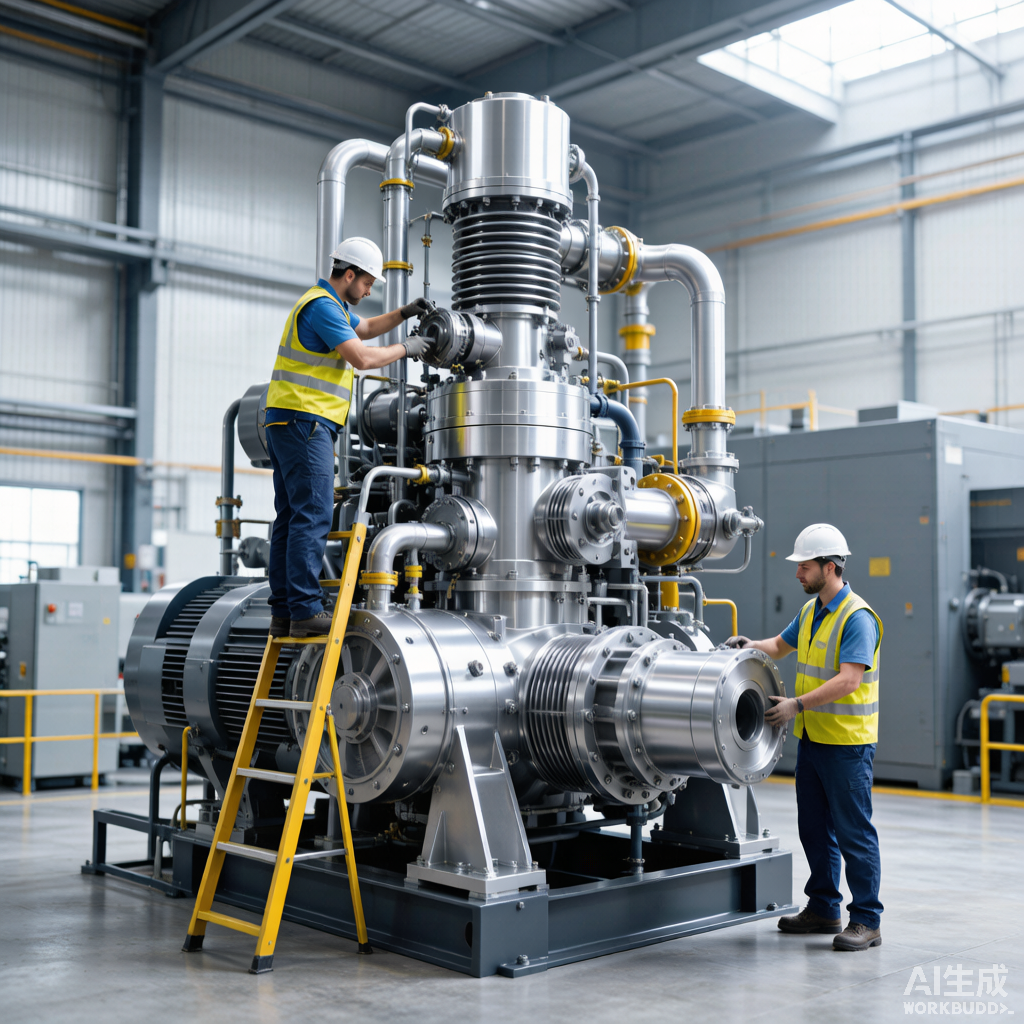
Reciprocating compressors are critical assets in oil refining, petrochemical, and natural gas processing facilities. Their reliable operation depends heavily on proper installation and commissioning procedures. This guide outlines the essential steps, best practices, and quality control measures that ensure long-term equipment reliability from day one.
1. Pre-Installation Preparation
Before the compressor arrives on site, a thorough pre-installation plan must be established. This includes foundation design verification, site readiness assessment, and logistical planning for heavy equipment handling.
- Review vendor installation drawings and technical specifications
- Verify foundation dimensions, anchor bolt patterns, and load-bearing capacity
- Prepare grout pads and ensure surface flatness within 0.5 mm/m tolerance
- Confirm utility availability: power, cooling water, instrument air, and nitrogen
- Inspect all piping spools for cleanliness and dimensional accuracy
2. Foundation and Grouting
The foundation is the structural basis for the entire compressor package. Epoxy grouting is preferred over cementitious grout for its superior chemical resistance, rapid cure time, and excellent vibration damping characteristics.
2.1 Foundation Acceptance Criteria
| Parameter | Acceptance Criteria | Measurement Method |
|---|---|---|
| Surface flatness | < 0.5 mm/m | Precision level |
| Anchor bolt spacing | ± 3 mm from drawing | Calibrated tape |
| Concrete strength | ≥ 28 MPa at 28 days | Core sample test |
| Surface roughness | 3-5 mm amplitude | Profile gauge |
2.2 Grouting Procedure
- Clean foundation surface to remove oil, grease, and loose particles
- Set compressor baseplate on shims at predetermined elevation
- Pour epoxy grout continuously to avoid cold joints and air entrapment
- Allow cure per manufacturer specification (typically 24-48 hours at 25 C)
- Remove shims and torque anchor bolts to specified values after full cure
3. Equipment Alignment
Proper alignment between the driver (motor or turbine) and the compressor is critical for minimizing vibration and extending bearing life. Both radial and angular misalignment must be corrected within vendor-specified tolerances.
- Perform rough alignment before grouting using dial indicators
- Conduct final precision alignment after grouting cure using laser alignment tools
- Check hot alignment after thermal stabilization at operating temperature
- Verify soft foot conditions and correct as needed with stainless shims
- Document all alignment readings for baseline reference
4. Piping Connection and Stress Relief
Process piping connections must be made without imposing external loads on compressor nozzles. Excessive piping stress can distort cylinder alignment, accelerate valve wear, and cause premature failure.
- Verify nozzle flange parallelism and face-to-face dimensions before bolting
- Use spring hangers and proper supports to minimize static pipe loads
- Conduct a piping flexibility analysis to confirm acceptable stress levels
- Perform hydrostatic testing of piping before final connection to compressor
- Install flexible connectors or expansion joints where thermal growth is expected
5. Commissioning and Startup
Commissioning is the final and most critical phase. It validates that all systems function together as designed and that the compressor is ready for sustained commercial operation.
5.1 Pre-Commissioning Checks
- Verify all instrumentation is calibrated and functional
- Confirm lube oil system is cleaned, flushed, and filled with correct oil grade
- Check all safety valves and pressure relief devices are set and tagged
- Test all interlocks and trip logic sequences
- Confirm cylinder cooling water system is operational
5.2 Initial Startup Sequence
| Step | Action | Acceptance |
|---|---|---|
| 1 | Pre-lube compressor for 15 minutes | Oil pressure stable |
| 2 | Bump motor rotation direction | Correct rotation confirmed |
| 3 | Run unloaded for 30 minutes | No abnormal noise/vibration |
| 4 | Load cylinders incrementally | Stage pressure stable |
| 5 | Monitor for 4-hour stability run | All parameters within spec |
Figure 1: Reciprocating compressor installation in a modern industrial facility
6. Performance Verification
After successful startup, a performance test should be conducted to verify that the compressor meets design throughput, pressure, and power consumption specifications. Any deviations should be documented and addressed through vendor service support or operational adjustments.
- Record actual vs. design capacity at various suction pressures
- Verify discharge temperature stays within API 618 limits (< 150 C)
- Measure rod load and confirm it remains within manufacturer rating
- Check packing leakage rates and seal effectiveness
- Document all baseline vibration spectra for future reference
7. Documentation and Handover
A complete documentation package is essential for long-term asset management. All installation records, alignment data, test results, and operating procedures must be compiled and transferred to the operations team.
- Compile installation data book with all alignment and grouting records
- Create baseline vibration and performance reference data
- Develop standard operating procedures (SOPs) for normal and emergency operations
- Train operators on startup, shutdown, and emergency response procedures
- Establish spare parts inventory with minimum stock levels
Source: Compressor Technology Editorial Reference