
Technical Properties, Process Improvements, and Industrial Application Guide for PTFE Seals
By Nick Li · August 10, 2026 · Technical Articles
Source: DLSEALS | Translated and edited for professional technical reference
In modern industrial fluid control and sealing engineering, as media corrosivity intensifies, system operating temperatures fluctuate drastically, and high-pressure conditions become prevalent, the limitations of traditional rubber and elastomer seals are increasingly apparent. Polytetrafluoroethylene (PTFE, commonly known as “King of Plastics”) seals, with their unparalleled chemical inertness, extremely wide temperature range, and exceptionally low friction coefficient, have become indispensable core sealing components in petrochemicals, semiconductor manufacturing, medical devices, and high-precision equipment.
1. Core Performance Advantages of PTFE Material
The ability of PTFE seals to maintain stable sealing under extreme conditions is primarily due to the strong C-F bonds in their molecular structure:
- Extremely Wide Temperature Range: PTFE can operate long-term within the temperature range of -200°C to +260°C, withstanding both liquid nitrogen-grade cryogenic temperatures and high-temperature steam and hot oil environments.
- Exceptional Chemical Stability: With the exception of molten alkali metals and elemental fluorine under high temperature and pressure, PTFE exhibits complete chemical inertness to virtually all strong acids, strong bases, strong oxidizers, and organic solvents.
- Self-Lubrication and Low Friction: Dynamic and static friction coefficients are extremely low (only 0.04-0.10), enabling smooth operation even under oil-free lubrication or dry friction conditions, effectively eliminating stick-slip phenomena.
- Aging Resistance and Low Water Absorption: PTFE features excellent weathering resistance, radiation resistance, and a water absorption rate approaching zero, ensuring that long-term storage and use do not result in performance degradation.
2. Limitations of Virgin PTFE and Modification Technologies
Although virgin PTFE possesses outstanding physical and chemical properties, its high cold flow (creep), low wear resistance, and insufficient tensile strength limit its direct application in high-pressure or high-speed reciprocating motion. To enhance its comprehensive mechanical properties, filler modification is commonly employed in engineering practice:
| Material Type | Core Advantages After Modification | Typical Application Scenarios |
|---|---|---|
| Bronze Powder | Significantly reduces creep; greatly improves thermal conductivity, hardness, and wear resistance | Heavy-duty hydraulic cylinder Glyd rings, wear rings, guide bands |
| Glass Fiber | Improves compressive strength and wear resistance; reduces thermal expansion coefficient and creep | Chemical pipeline valve gaskets, general valve seats |
| Carbon Fiber / Graphite | Excellent self-lubrication; outstanding friction resistance; strong anti-extrusion capability | Oil-free lubrication compressor seal rings, high-speed rotary shaft seals |
| MoS2 (Molybdenum Disulfide) | Reduces breakout friction; increases surface hardness | High-frequency reciprocating motion seals |
3. Typical PTFE Seal Structures and Engineering Applications
Combining modification technology with precision machining, PTFE seals have evolved into several classic industrial structural forms:
3.1 Spring-Energized Seal (Spring-Loaded PTFE Seal)
- Structural Composition: Consists of an outer modified PTFE sealing jacket and a built-in corrosion-resistant metal spring (V-type, U-type, or C-type spring).
- Dual Safeguard Mechanism: The PTFE modified jacket directly contacts the sealing medium and the sealed metal component (shaft/bore), providing a low-friction, corrosion-resistant dynamic/static contact surface. The metal spring is installed inside the jacket, providing continuous, permanent elastic preload to effectively compensate for sealing force decay caused by wear, temperature changes, or PTFE cold flow (creep).
- Operating Principle: Uses the built-in spring to provide initial preload force, combined with system media pressure to achieve secondary self-sealing.
- Application Scenarios: LNG cryogenic valves, aerospace hydraulic valves, semiconductor etching equipment, and other extreme environments.
3.2 Composite Seals (Glyd Ring / Step Seal)
- Structural Features: Composed of a PTFE stepped ring and a rubber O-ring that provides elastic preload force.
- Operating Principle: The O-ring provides stable radial elastic force, pressing the PTFE seal ring against the sealing surface, maintaining high-pressure sealing while reducing reciprocating motion friction through PTFE.
- Application Scenarios: Excavator main hydraulic cylinders, injection molding machine clamping cylinders, hydraulic cylinder piston and piston rod seals.
3.3 Expanded PTFE (ePTFE) Gasket
- Structural Features: Forms a porous, mesh-like fiber structure through a special stretching process.
- Operating Principle: Greatly preserves the corrosion resistance of PTFE while acquiring good flexibility and creep resistance, perfectly conforming to rough or uneven flange sealing surfaces.
- Application Scenarios: Enamel reaction kettles, glass pipeline flanges, strong acid and alkali storage tank seals.
PTFE Seal Component Reference
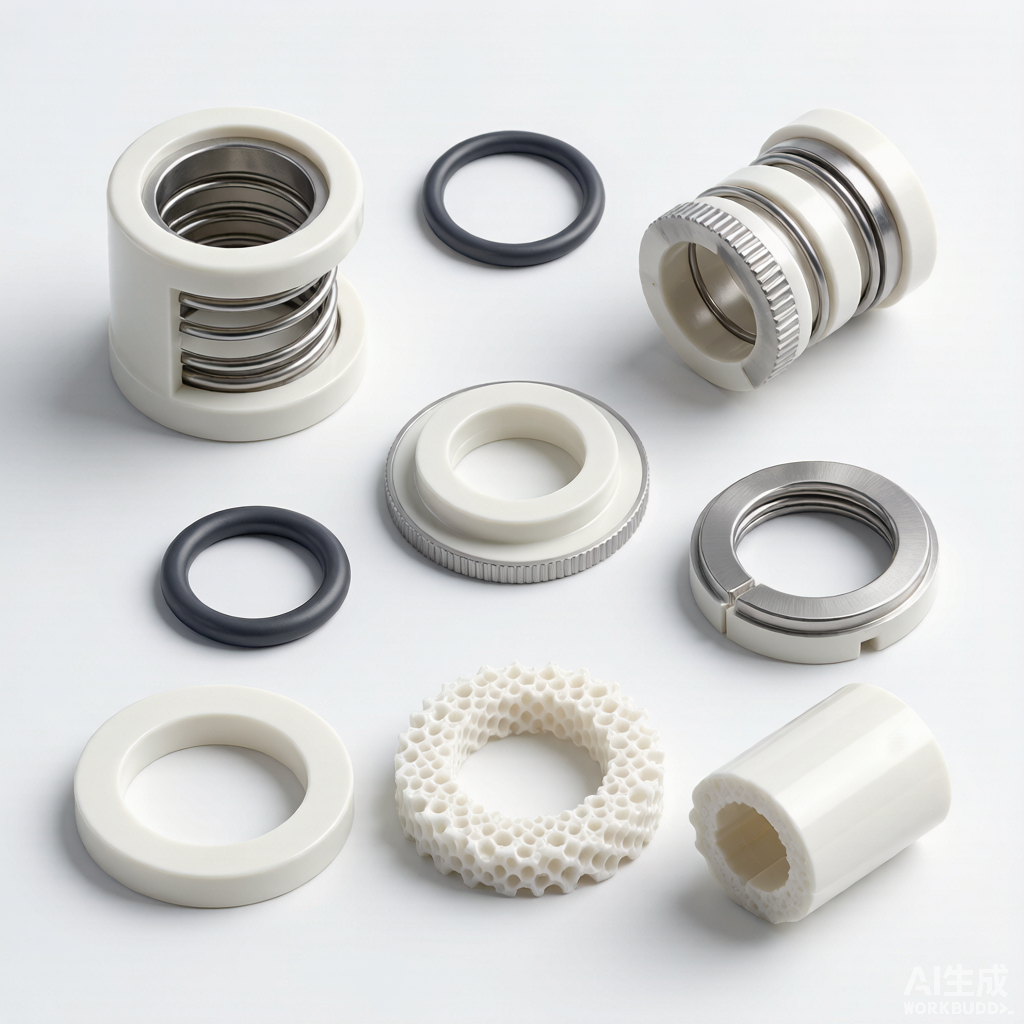
The figure below illustrates the structural forms of key PTFE seal types discussed in this guide:
Figure 1: PTFE seal components – spring-energized seal, Glyd ring with O-ring, and expanded PTFE gasket
4. Design, Machining, and Installation Practices
- Precision Machining: PTFE has low thermal conductivity and a high thermal expansion coefficient. During machining, sharp tools must be used and cutting heat must be controlled to prevent dimensional deviations caused by localized overheating.
- Groove and Chamfer Design: When assembling PTFE seal rings, shaft ends and groove entrances must be machined with 15-30 degree lead-in chamfers and thoroughly deburred to prevent sharp edges from cutting the PTFE lip.
- Dedicated Installation Tools: For PTFE composite seals in closed grooves, dedicated expansion and restoration tools must be used during installation. After the PTFE is expanded and pushed into the groove, a restoration sleeve must be used to return it to its original dimensions to ensure proper initial sealing contact pressure.
Conclusion
With the development of new materials and manufacturing processes, modified PTFE seals continue to evolve toward high-pressure, high-frequency, ultra-low-temperature, and contamination-free directions, becoming critical foundational components that ensure the safe and stable operation of modern high-end equipment. Proper material selection, structural design, precision machining, and standardized installation practices are essential to fully realize the performance advantages of PTFE seals in demanding industrial applications.
Source: DLSEALS WeChat Public Account. Translated and edited for English technical reference.