
Ultra High Purity Gas Delivery Systems for Semiconductor Manufacturing
By Nick Li · August 10, 2026 · Technical Articles
Ultra-high-purity (UHP) gas delivery systems are the lifelines of semiconductor fabrication facilities. These systems must deliver process gases from source to point-of-use (POU) without contamination, moisture ingress, or particle generation. This article examines the design principles, component selection, and operational considerations for UHP gas distribution systems.
1. System Architecture Overview
A typical UHP gas delivery system consists of source interface, distribution manifold, gas panel, and point-of-use delivery. Each section must maintain the gas purity level from the source cylinder to the process chamber.
- Source cabinet: houses gas cylinders with changeover manifold (VMB or VMP)
- Distribution piping: electropolished 316L tubing with VCR metal face seal connections
- Gas panel: integrates regulators, valves, filters, and monitoring instruments (IGS)
- Point of use (POU): final delivery with flow control and purity verification
- Exhaust and purge: safe handling of hazardous process gases
2. Component Selection Criteria
Every component in a UHP system must meet stringent material, surface finish, and cleanliness requirements. Component selection directly determines the achievable purity level at the point of use.
| Component | Material | Finish | Key Specification |
|---|---|---|---|
| Tube fittings | 316L VIM/VAR | EP (Ra < 5 microinch) | Metal face seal (VCR) |
| Tubing | 316L BA or EP | EP (Ra < 3 microinch) | ASTM A269/A213 |
| Valves | 316L body, PCTFE seat | EP internals | High cycle life, no outgassing |
| Regulators | 316L diaphragm | EP, metal-to-metal | Low SPE < 1% |
| Filters | 316L housing, PTFE membrane | EP | 0.003 micron, 6+ LRV |
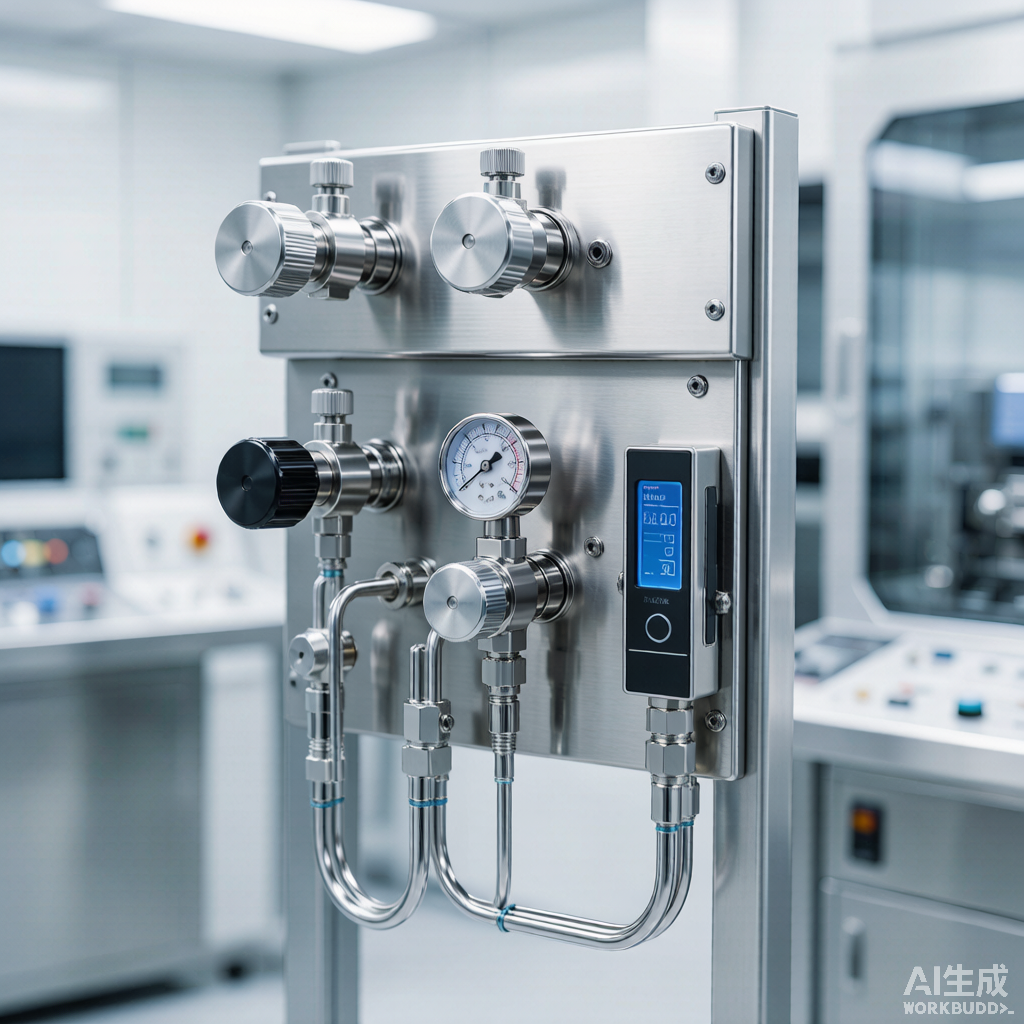
Figure 1: UHP gas delivery system panel with valves, regulators, and flow controllers
3. Cleanliness Standards (CFOS)
Components for UHP service must be processed through controlled cleaning procedures. Clean for Oxygen Service (CFOS) is a critical specification ensuring the removal of hydrocarbons and other contaminants that could cause combustion or contamination in oxygen-rich environments.
- Ultrasonic cleaning in alkaline solution to remove machining oils
- Acid passivation to remove free iron and enhance chromium oxide layer
- Electropolishing to remove surface peaks and reduce particulate entrapment
- High-purity nitrogen purge and cleanroom packaging
- Verify residual hydrocarbon level < 1 mg/m2 per SEMI specification
4. Leak Integrity Requirements
Leak integrity is paramount in UHP systems. Even minute leaks can introduce atmospheric contamination (moisture, oxygen, nitrogen) into the process gas stream, degrading semiconductor yield.
| Leak Test Method | Sensitivity (atm cc/sec) | Application |
|---|---|---|
| Bubble test | 10^-4 | General connection verification |
| Pressure decay | 10^-5 | System-level integrity |
| Helium sniffer | 10^-7 | Component-level testing |
| Helium hard vacuum | 10^-9 | UHP and hazardous gas systems |
5. Flow and Pressure Management
Consistent gas delivery requires careful management of flow rates and pressure differentials. Pressure regulators must minimize Supply Pressure Effect (SPE) to maintain stable outlet pressure as cylinder pressure decreases.
- Select regulators with SPE specification less than 1% of outlet set pressure
- Size flow components to maintain gas velocity below 25 m/s (80 ft/s) to minimize particle generation
- Consider two-stage regulation for high-pressure cylinder gases (e.g., H2 at 700 bar)
- Install pressure transducers at POU for continuous monitoring and feedback
- Design purge sequences to minimize gas waste while ensuring complete displacement
6. Specialty Gas Handling
Specialty gases used in semiconductor manufacturing include corrosive, pyrophoric, and toxic substances. These require dedicated gas cabinets with safety interlocks, purge systems, and continuous monitoring.
| Gas Category | Examples | Safety Requirement |
|---|---|---|
| Corrosive | HCl, Cl2, BCl3 | VMB with exhaust, N2 purge, gas detection |
| Pyrophoric | SiH4, PH3, B2H6 | Dedicated cabinet, fire detection, auto-shutoff |
| Toxic | AsH3, CO, NF3 | Scrubber interface, continuous area monitoring |
| Inert UHP | N2, Ar, He | Standard IGS panel, oxygen displacement monitoring |
7. System Validation and Maintenance
UHP gas systems require ongoing validation to ensure continued performance. Regular monitoring, scheduled maintenance, and component replacement programs maintain system integrity throughout the equipment life cycle.
- Perform continuous online moisture and oxygen monitoring at POU
- Conduct quarterly helium leak testing on all process connections
- Replace filter elements when differential pressure exceeds specified limit
- Schedule periodic particle counting to verify system cleanliness
- Document all maintenance activities in a CMMS for traceability
Source: FITOK Technical Reference